A Man Lay on the Road. An Officer Drove Over Him. Why No Charges Were Filed.
Updated On: April 16, 2026

The NY Attorney General's Office declined to charge an NYPD officer who ran over and killed Erasmo Huerta Gonzalez, who was lying on a roadway in Flushing Meadows Park.
On a sunny August afternoon in 2025, Erasmo Huerta Gonzalez lay down on a roadway in Flushing Meadows Corona Park. He was intoxicated, with a blood alcohol level more than three times the legal limit. His dark clothing blended into the dark asphalt in a shaded area. A marked NYPD car, driven by Officer Levonje Devone, approached at 7 miles per hour. The officer claims not to see him, then her car ran over him. He died hours later.
On April 14, 2026, the New York State Attorney General's Office of Special Investigation (OSI) announced that it would not seek criminal charges against Officer Devone. The decision has left many asking a difficult question: how can a driver who kills someone with their car face no legal consequences? For the readers of YourAccident.com, the answer lies in a specific, demanding legal standard for "criminally negligent homicide" in New York, and in a set of facts that, however tragic, did not meet it.
What Happened on August 23, 2025
According to the OSI's detailed report, the incident occurred at approximately 4:37 PM on a roadway by the Queens Theater in Flushing Meadows Corona Park. The road was not open to civilian traffic but was used by the NYPD, the Parks Department, and other authorized vehicles.
Mr. Huerta Gonzalez, 38, was lying on the roadway. Witnesses had seen him earlier sleeping against a wall of the theater. At 4:36 PM, one minute before the crash, a park employee texted an NYPD sergeant that a person was lying in the road outside the Queens Museum. A photo was attached.
Officer Devone and her partner, Officer Keisha Compere, were patrolling the park in a marked police car as part of a summer detail addressing quality-of-life issues. Devone was driving. She made a slow right turn onto United Nations Avenue South. The car was traveling at 7.14 miles per hour.
A civilian witness, CF, saw the car approach. She said the two officers appeared to be talking, but the driver was looking straight ahead—directly toward the man on the roadway. Another witness, Lt. Maritza Meade, saw the car moving slowly and rushed toward it, gesturing and trying to get the officers' attention. At 4:37 PM, the car shook as it went over what felt like a speed bump. It was not a speed bump. It was Mr. Huerta Gonzalez. The car dragged him approximately ten feet before stopping.
Officer Devone and Officer Compere immediately got out. They called for an ambulance. Mr. Huerta Gonzalez was conscious and able to communicate, giving his name. He was taken to New York Presbyterian Queens Hospital but became unresponsive during the ambulance ride. He was pronounced dead at 5:14 PM.
An autopsy determined the cause of death was blunt force trauma to the torso. His blood alcohol concentration was 0.256, more than three times the legal limit of 0.08.
Why 'Criminally Negligent Homicide' Is Hard to Prove
The OSI's decision not to charge Officer Devone was not a finding that she did nothing wrong. Rather, it was a determination that the evidence could not prove, beyond a reasonable doubt, that she committed a crime.
The relevant charge would have been criminally negligent homicide under New York Penal Law 125.10. That statute requires proof that the driver acted with "criminal negligence"—defined as a failure to perceive a "substantial and unjustifiable risk" that death would occur, and that this failure constitutes a "gross deviation" from the standard of care a reasonable person would observe.
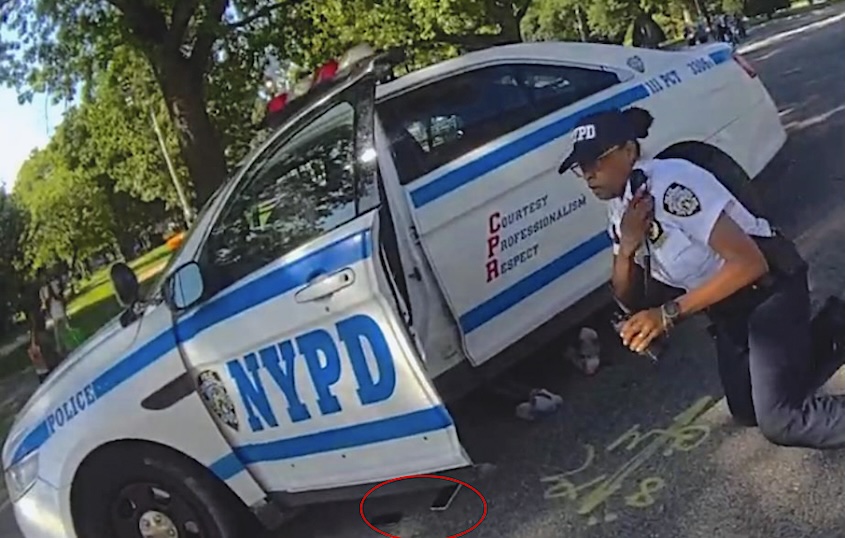
Still from Officer Devone’s BWC showing Mr. Huerta Gonzalez’s feet sticking out from under the police car. Taken from https://ag.ny.gov/sites/default/files/reports/osi-erasmo-huerta-gonzalez-report.pdf
But New York's highest court has added an extra layer. In a series of decisions, including People v. Cabrera (2008), the Court of Appeals has held that mere failure to perceive a risk is not enough, even if that failure is a "gross deviation." The prosecutor must also prove that the defendant committed an "additional affirmative act" or engaged in "risk-creating behavior" amounting to "seriously blameworthy carelessness."
In Cabrera, the court reversed a criminally negligent homicide conviction based on excessive speed alone, holding that "it takes some additional affirmative act by the defendant to transform speeding into dangerous speeding."
Applying the Law to the Facts
The OSI concluded that Officer Devone's actions did not meet this high bar. Several factors weighed in her favor:
- Speed was not a factor. The car was traveling at 7 mph, slower than a person jogging
- Visibility was poor. Officer Devone was driving into the sun, which obstructed her view
- The victim blended in. Mr. Huerta Gonzalez was wearing dark clothing and lying on dark asphalt in a shaded area
- His presence was unexpected. It is uncommon for a person to be lying down on a paved parkway. While a text had been sent to police, it is unclear whether Officer Devone received or saw it before the crash
- There was no evidence of distraction. Officer Devone had a tube of lip gloss in her hand, but her body camera showed she was looking forward. Cell phone records showed no calls or texts at the time of the crash. Her phone screen was locked when it fell to the ground
The OSI report concluded: "The collision appeared to be an accident rather than criminal conduct."
What This Means for Pedestrians and Drivers
This case is deeply troubling; a man is dead, and no one faces criminal consequences. But the legal reasoning, however unsatisfying, is grounded in a principle that protects all drivers: criminal negligence requires more than a mistake or an accident. It requires a level of carelessness that is "seriously blameworthy."
For pedestrians, the lesson is harsh but clear: lying on a roadway, especially while intoxicated and in dark clothing, is extraordinarily dangerous. Drivers cannot be expected to see what is not reasonably visible. The law does not hold drivers criminally responsible for hitting someone who is impossible to see.
For drivers, the case offers a different lesson: even when no criminal charges are filed, a fatal crash can still result in civil liability. The family of Mr. Huerta Gonzalez could potentially bring a wrongful death lawsuit against Officer Devone or the NYPD. The standard in civil court is lower—"preponderance of the evidence" rather than "beyond a reasonable doubt." And in civil cases, even a driver who is not criminally negligent can still be found financially responsible.
A Final Word
The death of Erasmo Huerta Gonzalez is a tragedy. He was a human being who made a terrible decision to lie down on a roadway while intoxicated. He paid for that decision with his life. Officer Devone, who likely carries the memory of that bump in the road every day, was found to have acted without criminal intent or gross negligence.
The criminal justice system does not always provide the answers we seek. But the civil justice system remains available to families who have lost loved ones, regardless of whether criminal charges are filed. And for all of us who use the roads, whether on foot or behind the wheel, this case is a reminder of the fragile, dangerous space we all share.
If you have lost a loved one in a crash and are seeking answers, the independent attorneys we connect you with have the experience to evaluate both criminal and civil avenues for accountability.
Tell us about your accident & get a free consultation now

Advertising is paid for by participating attorneys in a joint advertising program, licensed to practice law in their respective states. A complete list of joint advertising attorneys can be found here. You can request an attorney by name. We are not a law firm or an attorney referral service. This advertisement is not legal advice and is not a guarantee or prediction of the outcome of your legal matter. Every case is different. The outcome depends on the laws, facts, and circumstances unique to each case. Hiring an attorney is an important decision that should not be based solely on advertising. Request free information about your attorney's background and experience. This advertising does not imply a higher quality of legal services than that provided by other attorneys. This advertising does not imply that the attorneys are certified specialists or experts in any area of law. No legal services will be provided unless a signed agreement between the client and the attorney exists. We use cookies to personalize content and to analyze our traffic. We also share information about your use of our site with our analytics partners, who may combine it with other information you've provided or collected from your use of their services. You consent to our cookies if you continue to use our website.